The Luthier Test: A Guitar Maker Spent a Week Playing Games, and Her Notes Will Change How You Judge Them
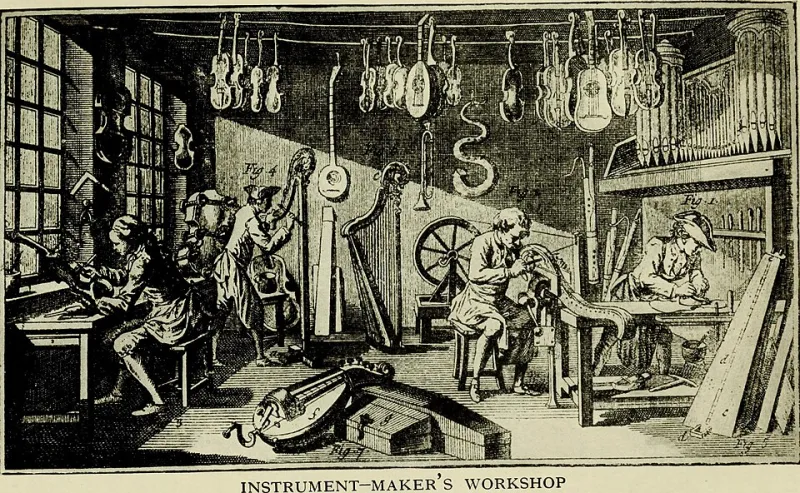
Photo: Singleton, Esther, d. 1930, No restrictions, via Wikimedia Commons
Mara Delgado builds guitars for a living. Not the kind you buy off a rack at Guitar Center — the kind that take four hundred hours, sit in a humidity-controlled shop in Asheville, North Carolina, and get sold to session players in Nashville who record the soundtracks you hear in trailers. She's also, as of two weeks ago, the person who made me feel like I've been reviewing games with one eye closed.
I spent a week watching her play. I asked her to narrate what she noticed, the way she'd notice a fret that sat a hair too proud of the fingerboard. What follows is part profile, part argument: game criticism has a craft-literacy problem, and people like Mara are the fix.
Tolerances Are a Language
The first thing Mara flagged wasn't a game at all. It was the controller.
"The stick has, what, maybe a millimeter of dead zone?" she said, tilting her character in Hollow Knight without moving the camera. "That's not a defect. That's a chosen tolerance. I do the same thing when I leave a ten-thousandth of breathing room in a neck joint so the wood can move with the seasons."
She's right, and it's a framing most reviews skip. We talk about "game feel" like it's weather — something that just happens. A luthier talks about feel as the sum of a thousand deliberate decisions, each one a tolerance someone set on purpose. When Doom Eternal hands you a dash that cancels on a single frame, that's not generosity. That's a maker deciding the instrument should respond to the player's lightest touch, the way a well-carved heel lets your fretting hand slide into the upper register without thinking.
By day two, she'd developed her own vocabulary. Games with mushy input buffers were "unfinished." Games where the animation blended seamlessly into player intent were "hand-rubbed." I started stealing her terms. They're better than mine.
The Sanding Stage Nobody Streams
Here's the thing about instrument making that most people never learn: the last ten percent of the work takes half the time. Scraping bindings. Leveling frets. Sanding from 120 grit to 2000. None of it shows in photos. All of it shows in your hands.
Mara noticed the gaming equivalent immediately — and noticed its absence faster.
"This menu animation," she said, watching a big-budget open world she'd asked me not to name, "the transition stutters right here. Every time. Whoever built this stopped at 600 grit and shipped it." Then, an hour later, playing Celeste for the first time: "Okay. This is 2000 grit. Everything I do, the game agrees with me instantly. There's no argument between me and the screen."
That's the whole review, isn't it? There's no argument between you and the screen. We've all played games where the argument never ends — the coyote time is off, the camera fights you, the jump arc lies. Mara's word for it: "sharp edges left inside the case. The buyer only finds them at home."
Materials Honesty
Day four, she played Outer Wilds and went quiet for a long time.
"This is quartersawn," she finally said. "You know how in tonewood, quartersawn grain is the stable cut? It's not the flashiest, but it doesn't warp. This game is built out of one idea — curiosity — and the grain runs straight through every system. The ship, the translation, the loop. Nothing's veneer."
Materials honesty. It's a concept from her shop that translates perfectly: does the game use its systems for what they actually are, or is there laminate over particle board somewhere? A survival game with crafting that exists only to pad the runtime is veneer. A puzzle game where every mechanic introduced in hour one matters in hour twenty is solid stock all the way through.
Five Games That Pass the Luthier Test
By the end of the week, Mara had a list. Her criteria: chosen tolerances, finish work you can feel, no hidden sharp edges, honest materials.
- Celeste — "2000 grit. The dash is a perfectly fitted joint."
- Outer Wilds — "Quartersawn grain, straight through the whole thing."
- Hollow Knight — "Heavy, dense wood. It takes effort to work, and that's the point."
- Tetris Effect — "A varnish you can see yourself in. Zero friction anywhere."
- Doom Eternal — "A power tool with perfect balance. You feel dangerous holding it."
Why This Matters for Criticism
Here's my argument, and Mara backs it: the gaming press keeps reviewing games from inside games. We compare them to other games, other engines, other sequels. But the most useful critical vocabulary I encountered this week came from a woman who builds wooden boxes with strings on them.
Craft literacy outside the medium — furniture making, cooking, machining, instrument building — gives us words for qualities games have but criticism rarely names. Tolerance. Finish. Grain. Fit. A woodworker doesn't call a chair "pretty good." She can tell you exactly which joint will fail in five years and why.
Imagine a review that could do that. Imagine knowing, on release day, which system in a game is the loose screw.
Mara's back in the shop now, working on a commission due in March. But she says she's keeping the controller charged. "Every craft is secretly about attention," she told me on her way out the door. "Games just hide theirs behind graphics. You sand long enough, you learn to see."
Maybe that's the takeaway. Play less like a consumer and more like a maker — and the games that were built with care will start to show you their joinery.